
On this World Photography Day—celebrated on August 19—you might be having a feeling we all recognize these days: you see a compelling photograph, but you’re not quite sure if you can trust it. Is it really a photo, or is it a generated image? Where did it come from, and how was it edited before it reached you?
For photographers and especially photojournalists, these uncertainties threaten to undermine the core of the mission—to share stories viewers can depend on. For Adobe Research, these same questions pose a challenge: how can we invent tools that let consumers understand what they’re seeing, so they know which images they can trust?
“Establishing trust in digital media is a socio-technical research challenge,” explains John Collomosse, a Senior Principal Scientist with Adobe Research. “We need new technologies that help people make more informed decisions, but equally importantly, we need a deep understanding of social factors such as digital literacy, how people interpret signals of authenticity, and how those technologies fit into the ways people create and consume content.”
In today’s world, trust in media is a complicated subject. An unedited photograph can tell an accurate story—or it can be presented in a misleading context. And sometimes, an AI-generated image can be the most powerful way to tell a factual story. In each of these cases, consumers need to know more than what they see on the surface.
So, instead of building tools that label images as “real,” Adobe Researchers are building tools that give consumers the information they need to understand where an image comes from, how it’s been changed, and whether its history can be independently verified. Taken together, researchers describe these critical elements as the provenance of an image.
For photojournalists, provenance tools help re-establish trust and protect ownership. “When photojournalists document conflicts, natural disasters, or breaking news, their photographs serve as evidence, so they need reliable ways to demonstrate where an image came from and whether it’s been altered. Similarly, photographers need reliable ways to show that they created an image themselves,” explains Adobe Research Scientist Shruti Agarwal. “Photographers have told us that provenance tools don’t just defend against misinformation. They preserve trust in photography itself.”

Building tools to track a photograph’s provenance and influences—no matter where it travels
In 2019, Adobe formed the Content Authenticity Initiative (CAI) to address the challenges of trust and attribution for content online. Collomosse and his team at Adobe Research help lead the group, which now has over 6,000 members worldwide. Together, they’ve contributed to Content Credentials, an open, cross-industry standard for recording provenance information inside digital content developed by the Coalition for Content Provenance and Authenticity, or C2PA.
Content Credentials use cryptographically signed metadata to record information about how a piece of content was created and changed. This can include the device or application used to create it, the edits that were made, and whether generative AI tools were involved.
Independent user studies show that Content Credentials help people determine the trustworthiness of an image, which is more needed than ever. A study published last year by the ACM found that people are about as accurate as a coin toss when it comes to detecting generated images. But having information about an image can ease the uncertainty and restore confidence. For example, a large-scale study by researchers at the University of Bergen found that displaying C2PA provenance information (the open technical standard established by the CAI) alongside news images significantly increased perceptions of transparency and credibility, as well as trust in the news source.
But provenance information doesn’t always travel seamlessly with an image, so Adobe Researchers are addressing that challenge, too. “Many platforms remove metadata during upload, which can break the connection between an image and its provenance information,” explains Agarwal.
Adobe researchers have developed complementary approaches that make provenance signals even more durable, including invisible watermarking and image fingerprinting. Invisible watermarks embed imperceptible signals directly into image pixels. These watermarks survive transformations like JPEG compression, resizing, cropping, screenshots, and social media processing. Fingerprinting techniques can also identify previously seen images, even after modifications, helping reconnect content with its original provenance records.
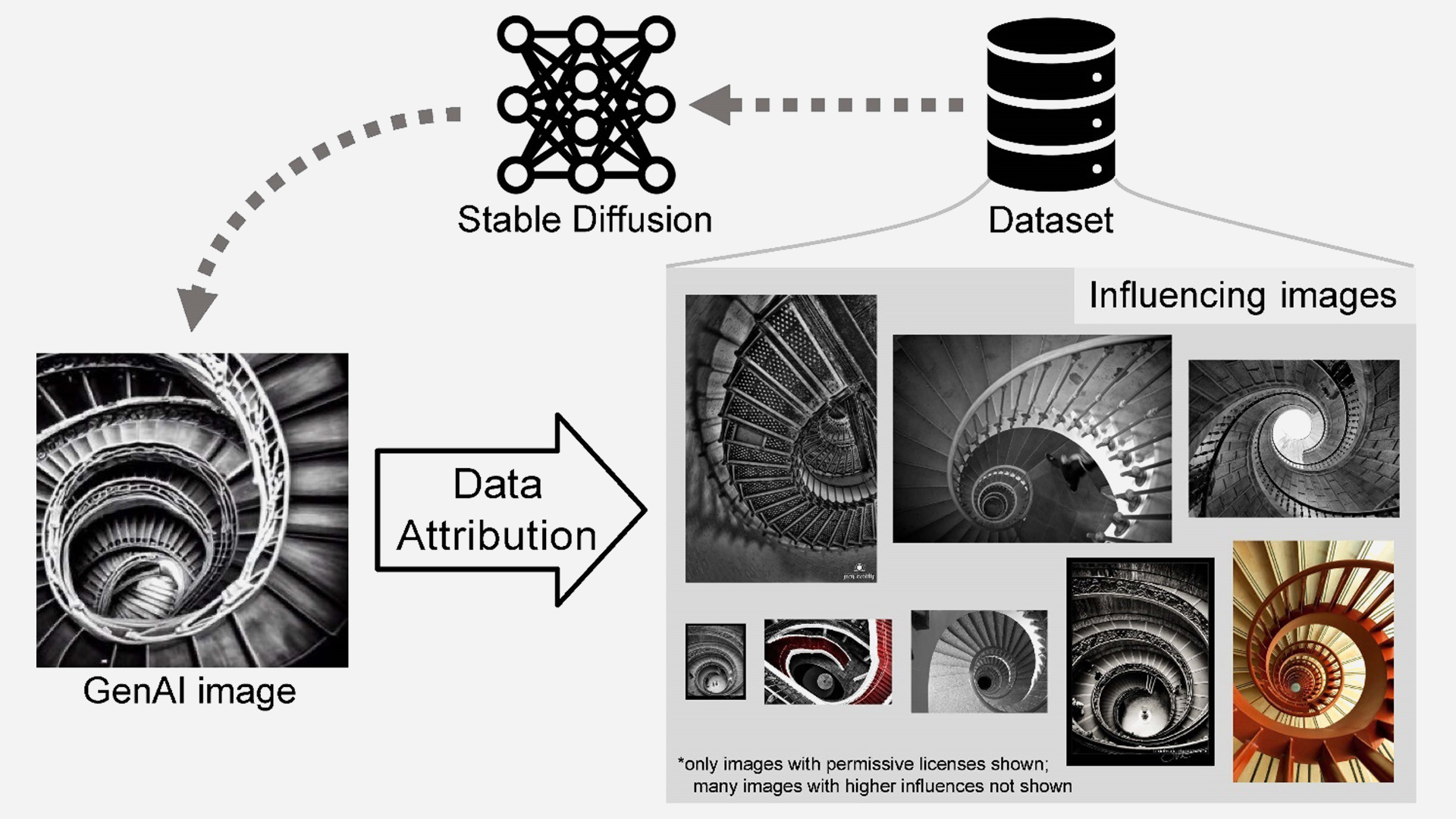
Beyond tracking the provenance of photographs, Adobe researchers are also developing tools, including EKILA, ProMark, TokenTrace, Attribution by Customization (AbC) and Unlearning (AbU), and FastGDA that allow viewers to understand more about the ingredients that go into generated images, including data, assets, and artistic influences. TokenTrace, for example, is a new method that uses lightweight watermarks to trace the visual concepts that an AI model used to create an image. Attribution by Unlearning (AbU) uses machine unlearning to remove a synthesized image from a model, identifying its most influential training images as those the model forgets in the process; Fast Data Attribution then distills this heavy operation into a lightweight, search-based process.
“By allowing users to see the source materials for a synthetic image, we can support better attribution, more transparent licensing, and greater accountability throughout the AI content supply chain,” explains Collomosse.
All of this may lead to new ways to recognize and reward creative works. And it’s beginning to influence the larger public debate about AI and copyright. For example, the UK House of Lords Communications and Digital Committee’s 2026 inquiry into AI, copyright, and the creative industries drew extensively on Adobe Research work as it considered tools for greater AI transparency, attribution, and licensing.
Sleuthing out manipulated images
Not all images have their provenance attached, but a group of forensic experts at Adobe Research have some pretty amazing tricks up their sleeves if they want to discover an image’s hidden story. “Generative AI models and editing tools are getting so good, but researchers still have an advantage. A manipulated image has to get everything right, while a detection model only has to see one thing that is not right,” explains Adobe Principal Scientist Richard Zhang. A small clue, such as inconsistent geometry, a jumbled bit of text, or even an imperceptibly small sampling mismatch, leaves room for detection.
For example, Zhang and his team created a dataset of faces that were warped using Photoshop and then used them to train an AI model to detect if—and how—an image of a face has been warped—and even reverse the process. This is especially valuable as AI models get better and better at generating realistic faces—a recent study in the journal Cognitive Research: Principles and Implications showed that people cannot reliably distinguish between photos and generated images of real or fictional people.

Since the earliest days of generative AI, Zhang and his collaborators at UC Berkeley have also been building tools to keep up with detecting generated images—an especially big challenge given how rapidly generative AI tools are changing. Among their successes, they’ve developed a detection model that can recognize a generated image, even if it’s been created by a new AI model their tool has never seen before. Their research has been used to monitor uploads to Adobe Stock, helping to encourage complicance with the policy that all generative AI content should be identified.
While Zhang’s team builds technologies that detect manipulation, they recognize that almost all content is manipulated in one way or another by editing, resizing, or other changes. In fact, a recent Adobe study of 2,000 creative professionals across the US, UK, and Japan, found that 39% of professional photographers use AI tools daily in their standard editing work. So it’s important to note that simply detecting changes isn’t the same as understanding the meaning or impact of them.
“Viewing and judging whether something is ‘real’ or ‘fake’ is an overly broad casting of the problem. For example, you might enhance the resolution of an image, which, if done correctly, generates many pixels without really changing the image content. Conversely, a small edit on a person’s facial expression could have a huge impact while only touching a small percentage of the pixels,” says Zhang. “Ultimately, we’d like technologies, both provenance and detection, that can backtrack and predict the chain of operations that have been used, allowing the end consumer to judge the holistic impact of them.”
Looking ahead to a fairer, more trustworthy digital world
Tools like Content Credentials and TokenTrace are designed to help consumers understand what they see, and to help photographers demonstrate the credibility of their work—and claim proper credit for it. As researchers look into the future, they’re also thinking about how to extend tools like these to emerging questions, such as personality rights, likeness, and privacy.
“Ultimately, provenance has the potential to become digital infrastructure for the creative economy,” says Collomosse. “The goal is to create a fairer digital supply chain in which agency and value remain connected to those who create—and to build a system where people have the information they need to know what they can trust.”
Wondering what else is happening in Adobe Research? Check out our latest news here.

